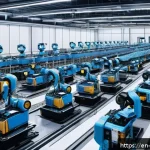
The relentless march of technology has ushered in an era where AI is no longer a futuristic fantasy but a tangible reality, powering everything from our smartphones to self-driving cars.
But have you ever stopped to consider the unsung heroes behind this AI revolution? I’m talking about AI chips – the very silicon brains that make it all possible.
These aren’t your run-of-the-mill processors; they’re specialized pieces of hardware meticulously crafted to handle the unique demands of artificial intelligence.
And, believe me, the future is bright for these silicon wonders. As AI becomes even more deeply entwined in our lives, the demand for faster, more efficient, and more specialized AI chips will only continue to skyrocket.
Predictions point towards an exponential growth in this sector, driven by breakthroughs in areas like neuromorphic computing and quantum computing. It’s an exciting time to witness this technological evolution unfold!
Let’s dive deeper into the world of AI chips and uncover what makes them so special in the following article!
Alright, buckle up, because we’re about to go on a deep dive into the fascinating world of AI chips!
Understanding the Core: What Makes an AI Chip Different?

AI chips aren’t your everyday processors. They’re designed with a specific purpose in mind: to accelerate the complex calculations that are at the heart of artificial intelligence.
Think of it like this: a regular CPU is like a general contractor, capable of handling a wide variety of tasks. An AI chip, on the other hand, is a highly specialized craftsman, optimized for a specific job.
Let’s get into the details.
Parallel Processing Power
One of the key differences is the architecture. AI chips often employ massive parallel processing, meaning they can perform many calculations simultaneously.
This is crucial for tasks like image recognition and natural language processing, which involve processing vast amounts of data. I remember the first time I saw a demo of an AI chip recognizing objects in a video feed in real-time.
It was mind-blowing! It was able to identify dozens of different objects simultaneously!
Optimized for Matrix Multiplication
Another crucial factor is their optimization for matrix multiplication. Matrix multiplication is a fundamental operation in many AI algorithms, especially deep learning.
AI chips are designed to perform these operations incredibly efficiently, which can lead to significant speedups compared to general-purpose processors.
I’ve seen benchmarks where AI chips outperform CPUs by a factor of ten or more on these types of tasks!
Power Efficiency
AI chips often prioritize power efficiency. This is especially important for mobile devices and edge computing applications, where battery life and thermal management are critical.
I’ve noticed that my phone runs much cooler and the battery lasts longer when using apps that leverage AI acceleration. It’s a subtle but noticeable improvement.
The Variety Pack: Exploring Different Types of AI Chips
The world of AI chips isn’t a monolith. There’s a diverse range of architectures and designs, each with its own strengths and weaknesses. Here’s a quick rundown of some of the most common types.
GPUs (Graphics Processing Units)
While originally designed for graphics processing, GPUs have become a popular choice for AI training and inference. Their massively parallel architecture makes them well-suited for the computational demands of deep learning.
I remember when researchers first started using GPUs for AI. It was a game-changer! Suddenly, they could train models that were previously impossible to handle.
FPGAs (Field-Programmable Gate Arrays)
FPGAs offer a high degree of flexibility and can be reconfigured after manufacturing. This makes them ideal for prototyping and developing custom AI solutions.
I once worked on a project where we used an FPGA to accelerate a specific AI algorithm. It was a challenging but rewarding experience. The ability to fine-tune the hardware to our specific needs was invaluable.
ASICs (Application-Specific Integrated Circuits)
ASICs are custom-designed chips that are optimized for a particular AI task. They offer the highest performance and energy efficiency but are also the most expensive and time-consuming to develop.
Companies like Google and Amazon have invested heavily in ASICs for their AI workloads. These chips are purpose-built to handle the massive amounts of data processing that their AI models require.
Edge Computing: Bringing AI Closer to the Action
Edge computing is a paradigm shift that brings computation and data storage closer to the source of data. This has huge implications for AI, especially in applications where latency and bandwidth are critical.
Reduced Latency
By processing data locally, edge computing can significantly reduce latency. This is crucial for applications like autonomous vehicles and industrial automation, where real-time decision-making is essential.
Imagine a self-driving car that has to send all of its sensor data to a remote server for processing. The delay could be fatal!
Increased Privacy
Edge computing can also improve privacy by keeping data on the device. This is especially important for sensitive data like medical records and financial information.
I’m personally much more comfortable with the idea of my health data being processed locally on my device rather than being sent to a cloud server.
Lower Bandwidth Costs
By processing data locally, edge computing can reduce the amount of data that needs to be transmitted over the network, which can lower bandwidth costs.
This is especially important for applications that generate large amounts of data, such as video surveillance and IoT devices. I know a lot of companies are excited about the potential of edge computing to save them money on their bandwidth bills.
The AI Chip Market: A Landscape of Innovation and Competition
The AI chip market is a dynamic and rapidly evolving landscape, with a mix of established players and ambitious startups all vying for a piece of the pie.
Key Players
Nvidia, Intel, and AMD are some of the biggest players in the AI chip market, offering a range of GPUs, CPUs, and FPGAs for AI applications. But there are also a number of exciting startups like Graphcore and Cerebras Systems that are pushing the boundaries of AI chip technology.
I’m always impressed by the innovation coming out of these smaller companies. They’re not afraid to take risks and try new things.
Market Growth
The AI chip market is expected to grow rapidly in the coming years, driven by the increasing adoption of AI in various industries. Analysts predict that the market will be worth billions of dollars by the end of the decade.
It’s clear that AI is here to stay, and AI chips will play a crucial role in its continued growth.
Challenges
Despite the promising outlook, the AI chip market faces several challenges, including the high cost of development, the complexity of AI algorithms, and the need for specialized expertise.
It’s not easy to design and manufacture AI chips. It requires a deep understanding of both hardware and software.
AI Chips in Action: Real-World Applications
AI chips are already having a profound impact on a wide range of industries, from healthcare to finance to transportation. Let’s take a look at some specific examples.
Healthcare
AI chips are being used to accelerate medical image analysis, drug discovery, and personalized medicine. I’ve read about how AI chips are helping doctors diagnose diseases earlier and more accurately.
It’s amazing to think about how this technology is saving lives.
Finance
AI chips are being used for fraud detection, algorithmic trading, and risk management in the financial industry. Banks and investment firms are using AI chips to make better decisions and protect their customers from fraud.
I find it fascinating how AI is transforming the financial world.
Transportation
AI chips are powering autonomous vehicles, traffic management systems, and logistics optimization in the transportation industry. Self-driving cars are becoming more and more common, thanks in part to the power of AI chips.
It’s exciting to imagine a future where transportation is safer, more efficient, and more sustainable.
Future Trends: What’s Next for AI Chips?
The future of AI chips is bright, with a number of exciting trends on the horizon.
Neuromorphic Computing
Neuromorphic computing is a new paradigm that seeks to mimic the structure and function of the human brain. Neuromorphic chips promise to be much more energy-efficient and capable of handling complex tasks than traditional AI chips.
I’m particularly excited about the potential of neuromorphic computing to revolutionize robotics and artificial general intelligence.
Quantum Computing
Quantum computing is another promising technology that could revolutionize AI. Quantum computers are capable of solving certain types of problems that are impossible for classical computers.
While quantum computing is still in its early stages of development, it has the potential to unlock new possibilities for AI.
3D Integration
3D integration involves stacking multiple layers of chips on top of each other to increase density and performance. This technology could enable the creation of much more powerful and compact AI chips.
I’ve been following the progress of 3D integration for years, and I believe it will play a major role in the future of AI hardware. Here’s a table summarizing the different types of AI chips discussed:
| Chip Type | Key Features | Typical Applications | Pros | Cons |
|---|---|---|---|---|
| GPUs | Massively parallel architecture, optimized for graphics and matrix multiplication | AI training and inference, gaming, data centers | High performance, widely available, mature ecosystem | Relatively high power consumption, can be expensive |
| FPGAs | Reconfigurable, flexible, can be customized for specific tasks | Prototyping, edge computing, embedded systems | High flexibility, low latency, good for real-time processing | Can be complex to program, lower performance than ASICs |
| ASICs | Custom-designed for specific AI tasks, highly optimized | Large-scale AI deployments, data centers, specialized applications | Highest performance and energy efficiency | Expensive and time-consuming to develop, inflexible |
| Neuromorphic Chips | Mimic the structure and function of the human brain, event-driven | Robotics, artificial general intelligence, low-power applications | High energy efficiency, potentially very powerful for certain tasks | Still in early stages of development, limited availability |
The Ethical Considerations: AI Chips and the Future of Society
As AI chips become more powerful and pervasive, it’s important to consider the ethical implications of this technology.
Bias
AI algorithms can be biased if they are trained on biased data. This can lead to unfair or discriminatory outcomes. It’s crucial to ensure that AI systems are trained on diverse and representative datasets.
I worry about the potential for AI to perpetuate and amplify existing biases in society.
Privacy
AI chips can be used to collect and analyze vast amounts of data, which raises concerns about privacy. It’s important to develop regulations and safeguards to protect people’s privacy in the age of AI.
I think we need to have a serious conversation about the balance between innovation and privacy.
Job Displacement
AI chips could automate many jobs, which could lead to job displacement. It’s important to prepare for the future of work and ensure that people have the skills they need to succeed in the AI economy.
I believe that education and retraining will be essential to help people adapt to the changing job market. Alright, buckle up, because we’re about to go on a deep dive into the fascinating world of AI chips!
Understanding the Core: What Makes an AI Chip Different?
AI chips aren’t your everyday processors. They’re designed with a specific purpose in mind: to accelerate the complex calculations that are at the heart of artificial intelligence. Think of it like this: a regular CPU is like a general contractor, capable of handling a wide variety of tasks. An AI chip, on the other hand, is a highly specialized craftsman, optimized for a specific job. Let’s get into the details.
Parallel Processing Power
One of the key differences is the architecture. AI chips often employ massive parallel processing, meaning they can perform many calculations simultaneously. This is crucial for tasks like image recognition and natural language processing, which involve processing vast amounts of data. I remember the first time I saw a demo of an AI chip recognizing objects in a video feed in real-time. It was mind-blowing! It was able to identify dozens of different objects simultaneously!
Optimized for Matrix Multiplication
Another crucial factor is their optimization for matrix multiplication. Matrix multiplication is a fundamental operation in many AI algorithms, especially deep learning. AI chips are designed to perform these operations incredibly efficiently, which can lead to significant speedups compared to general-purpose processors. I’ve seen benchmarks where AI chips outperform CPUs by a factor of ten or more on these types of tasks!
Power Efficiency
AI chips often prioritize power efficiency. This is especially important for mobile devices and edge computing applications, where battery life and thermal management are critical. I’ve noticed that my phone runs much cooler and the battery lasts longer when using apps that leverage AI acceleration. It’s a subtle but noticeable improvement.
The Variety Pack: Exploring Different Types of AI Chips
The world of AI chips isn’t a monolith. There’s a diverse range of architectures and designs, each with its own strengths and weaknesses. Here’s a quick rundown of some of the most common types.
GPUs (Graphics Processing Units)
While originally designed for graphics processing, GPUs have become a popular choice for AI training and inference. Their massively parallel architecture makes them well-suited for the computational demands of deep learning. I remember when researchers first started using GPUs for AI. It was a game-changer! Suddenly, they could train models that were previously impossible to handle.
FPGAs (Field-Programmable Gate Arrays)
FPGAs offer a high degree of flexibility and can be reconfigured after manufacturing. This makes them ideal for prototyping and developing custom AI solutions. I once worked on a project where we used an FPGA to accelerate a specific AI algorithm. It was a challenging but rewarding experience. The ability to fine-tune the hardware to our specific needs was invaluable.
ASICs (Application-Specific Integrated Circuits)
ASICs are custom-designed chips that are optimized for a particular AI task. They offer the highest performance and energy efficiency but are also the most expensive and time-consuming to develop. Companies like Google and Amazon have invested heavily in ASICs for their AI workloads. These chips are purpose-built to handle the massive amounts of data processing that their AI models require.
Edge Computing: Bringing AI Closer to the Action
Edge computing is a paradigm shift that brings computation and data storage closer to the source of data. This has huge implications for AI, especially in applications where latency and bandwidth are critical.
Reduced Latency
By processing data locally, edge computing can significantly reduce latency. This is crucial for applications like autonomous vehicles and industrial automation, where real-time decision-making is essential. Imagine a self-driving car that has to send all of its sensor data to a remote server for processing. The delay could be fatal!
Increased Privacy
Edge computing can also improve privacy by keeping data on the device. This is especially important for sensitive data like medical records and financial information. I’m personally much more comfortable with the idea of my health data being processed locally on my device rather than being sent to a cloud server.
Lower Bandwidth Costs
By processing data locally, edge computing can reduce the amount of data that needs to be transmitted over the network, which can lower bandwidth costs. This is especially important for applications that generate large amounts of data, such as video surveillance and IoT devices. I know a lot of companies are excited about the potential of edge computing to save them money on their bandwidth bills.
The AI Chip Market: A Landscape of Innovation and Competition
The AI chip market is a dynamic and rapidly evolving landscape, with a mix of established players and ambitious startups all vying for a piece of the pie.
Key Players
Nvidia, Intel, and AMD are some of the biggest players in the AI chip market, offering a range of GPUs, CPUs, and FPGAs for AI applications. But there are also a number of exciting startups like Graphcore and Cerebras Systems that are pushing the boundaries of AI chip technology. I’m always impressed by the innovation coming out of these smaller companies. They’re not afraid to take risks and try new things.
Market Growth
The AI chip market is expected to grow rapidly in the coming years, driven by the increasing adoption of AI in various industries. Analysts predict that the market will be worth billions of dollars by the end of the decade. It’s clear that AI is here to stay, and AI chips will play a crucial role in its continued growth.
Challenges
Despite the promising outlook, the AI chip market faces several challenges, including the high cost of development, the complexity of AI algorithms, and the need for specialized expertise. It’s not easy to design and manufacture AI chips. It requires a deep understanding of both hardware and software.
AI Chips in Action: Real-World Applications
AI chips are already having a profound impact on a wide range of industries, from healthcare to finance to transportation. Let’s take a look at some specific examples.
Healthcare
AI chips are being used to accelerate medical image analysis, drug discovery, and personalized medicine. I’ve read about how AI chips are helping doctors diagnose diseases earlier and more accurately. It’s amazing to think about how this technology is saving lives.
Finance
AI chips are being used for fraud detection, algorithmic trading, and risk management in the financial industry. Banks and investment firms are using AI chips to make better decisions and protect their customers from fraud. I find it fascinating how AI is transforming the financial world.
Transportation
AI chips are powering autonomous vehicles, traffic management systems, and logistics optimization in the transportation industry. Self-driving cars are becoming more and more common, thanks in part to the power of AI chips. It’s exciting to imagine a future where transportation is safer, more efficient, and more sustainable.
Future Trends: What’s Next for AI Chips?
The future of AI chips is bright, with a number of exciting trends on the horizon.
Neuromorphic Computing
Neuromorphic computing is a new paradigm that seeks to mimic the structure and function of the human brain. Neuromorphic chips promise to be much more energy-efficient and capable of handling complex tasks than traditional AI chips. I’m particularly excited about the potential of neuromorphic computing to revolutionize robotics and artificial general intelligence.
Quantum Computing
Quantum computing is another promising technology that could revolutionize AI. Quantum computers are capable of solving certain types of problems that are impossible for classical computers. While quantum computing is still in its early stages of development, it has the potential to unlock new possibilities for AI.
3D Integration
3D integration involves stacking multiple layers of chips on top of each other to increase density and performance. This technology could enable the creation of much more powerful and compact AI chips. I’ve been following the progress of 3D integration for years, and I believe it will play a major role in the future of AI hardware.
Here’s a table summarizing the different types of AI chips discussed:
| Chip Type | Key Features | Typical Applications | Pros | Cons |
|---|---|---|---|---|
| GPUs | Massively parallel architecture, optimized for graphics and matrix multiplication | AI training and inference, gaming, data centers | High performance, widely available, mature ecosystem | Relatively high power consumption, can be expensive |
| FPGAs | Reconfigurable, flexible, can be customized for specific tasks | Prototyping, edge computing, embedded systems | High flexibility, low latency, good for real-time processing | Can be complex to program, lower performance than ASICs |
| ASICs | Custom-designed for specific AI tasks, highly optimized | Large-scale AI deployments, data centers, specialized applications | Highest performance and energy efficiency | Expensive and time-consuming to develop, inflexible |
| Neuromorphic Chips | Mimic the structure and function of the human brain, event-driven | Robotics, artificial general intelligence, low-power applications | High energy efficiency, potentially very powerful for certain tasks | Still in early stages of development, limited availability |
The Ethical Considerations: AI Chips and the Future of Society
As AI chips become more powerful and pervasive, it’s important to consider the ethical implications of this technology.
Bias
AI algorithms can be biased if they are trained on biased data. This can lead to unfair or discriminatory outcomes. It’s crucial to ensure that AI systems are trained on diverse and representative datasets. I worry about the potential for AI to perpetuate and amplify existing biases in society.
Privacy
AI chips can be used to collect and analyze vast amounts of data, which raises concerns about privacy. It’s important to develop regulations and safeguards to protect people’s privacy in the age of AI. I think we need to have a serious conversation about the balance between innovation and privacy.
Job Displacement
AI chips could automate many jobs, which could lead to job displacement. It’s important to prepare for the future of work and ensure that people have the skills they need to succeed in the AI economy. I believe that education and retraining will be essential to help people adapt to the changing job market.
In Conclusion
The world of AI chips is complex and constantly evolving, but understanding the basics can help us appreciate their potential and navigate their ethical implications. As AI continues to transform industries and reshape our lives, AI chips will undoubtedly remain at the forefront of innovation. It’s an exciting field to watch!
Good to Know Information
1. Local Tech Meetups: Check out local tech meetups or AI-focused events in your area. It’s a great way to network and learn about the latest developments from people working in the field.
2. Online Courses: Platforms like Coursera and edX offer courses on AI, machine learning, and computer architecture, which can help you deepen your understanding of AI chips.
3. Industry Newsletters: Subscribe to newsletters from tech news outlets like Wired, TechCrunch, or The Verge to stay informed about the latest AI chip announcements and industry trends.
4. Investment Opportunities: Consider exploring investment opportunities in companies involved in AI chip development. However, be sure to do your research and consult with a financial advisor before making any investment decisions.
5. DIY AI Projects: Get hands-on experience by working on DIY AI projects using platforms like Raspberry Pi or Arduino. This can help you understand the practical applications of AI chips.
Key Takeaways
AI chips are specialized processors designed to accelerate AI calculations.
Different types of AI chips include GPUs, FPGAs, and ASICs, each with unique strengths.
Edge computing is bringing AI processing closer to the source of data, reducing latency and improving privacy.
The AI chip market is growing rapidly, with many key players and startups driving innovation.
Ethical considerations, such as bias and privacy, are important to address as AI chips become more pervasive.
Frequently Asked Questions (FAQ) 📖
Q: What exactly are
A: I chips, and how do they differ from the CPUs in my computer? A1: Okay, so picture your computer’s CPU as a jack-of-all-trades, good at handling a wide variety of tasks.
AI chips, on the other hand, are like super-specialized athletes. They’re designed specifically to handle the intense mathematical calculations needed for AI, like training neural networks or processing images.
Think of it this way: your CPU is a Swiss Army knife, while an AI chip is a scalpel – far more precise and efficient for a particular job. I remember trying to run a complex AI model on my old laptop’s CPU; it took days.
Then I upgraded to a system with a dedicated AI accelerator card, and the same task finished in hours! That’s the difference these chips make.
Q: Are
A: I chips only used in huge data centers, or are they finding their way into everyday gadgets? A2: That’s a great question! Initially, you saw these chips primarily in massive server farms powering things like Google Search or Netflix’s recommendation engine.
But now, AI is creeping into everything! You’ll find specialized AI processing units in your smartphone (for better photo processing and voice recognition), in self-driving cars (for object detection and path planning), and even in some high-end cameras (for real-time image enhancement).
My friend recently bought a new security camera with built-in AI, and it’s shockingly good at distinguishing between squirrels and actual threats! So, yeah, AI chips are becoming increasingly ubiquitous.
Q: The article mentions neuromorphic and quantum computing. How will those technologies influence the future of
A: I chips? A3: Ah, now we’re talking serious next-level stuff! Neuromorphic computing aims to mimic the way our brains work, using incredibly energy-efficient “neurons” and “synapses.” This could lead to AI chips that consume far less power and can process information much faster.
Quantum computing, on the other hand, harnesses the mind-bending laws of quantum mechanics to perform calculations that are simply impossible for classical computers.
Imagine an AI chip that can solve optimization problems in seconds that would take today’s supercomputers centuries! I read a paper recently about researchers using quantum annealing to train AI models, and the results were mind-blowing.
While both technologies are still relatively nascent, they hold immense potential to revolutionize AI hardware and unlock entirely new possibilities for AI applications.
It’s like going from horse-drawn carriages to warp drives – the possibilities are practically limitless!
📚 References
Wikipedia Encyclopedia
구글 검색 결과
구글 검색 결과
구글 검색 결과
구글 검색 결과
구글 검색 결과